
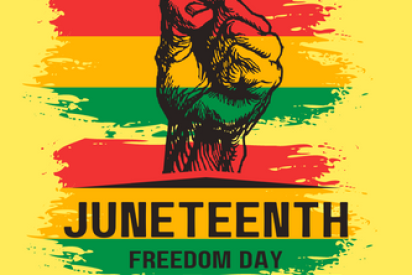
In today’s political climate, it would be easy for some to dismiss Juneteenth—now a federal holiday commemorating the end of chattel slavery in the United States—as an outgrowth of a social movement, one with little significance except to a group of people whose ancestors were directly impacted by it.
The reality is that Juneteenth should be viewed not only as an opportunity to recognize Black people’s history in America, but that of America as a whole and its continuing journey towards equity and inclusion…a journey that itself was slow in beginning.
Slavery had effectively ended with the signing of the Emancipation Proclamation by President Abraham Lincoln in January 1863, but it wouldn’t be enforced until the end of the Civil War, which was triggered by the surrender of Confederate Gen. Robert E. Lee in Virginia in April 1865.
Still, it wasn’t until June 19, 1865, when word reached parts of Texas, then the westernmost of the former Confederate states. That was when U.S. Maj. Gen. Gordon Granger delivered to the people of Galveston General Order No. 3, which read, in part: “The people of Texas are informed that, in accordance with the proclamation from the Executive of the United States, all slaves are free. This involves an absolute equality of personal rights of property between former masters and slaves, and the connection heretofore existing between them becomes that between employer and hired labor.”
That day became known as “Juneteenth,” short for June 19. It wasn’t until Dec. 6 of that year when the states ratified the 13th amendment to the Constitution, which had been passed by Congress ten months earlier, abolishing the institution of slavery.
A little-known fact related to this day is that Texas, perhaps fittingly, was the first state to formally recognize Juneteenth in 1980. Back then, it was called “Emancipation Day.” Some of its earliest observances occurred in the city of Galveston, where Maj. Gen. Granger had read General Order No. 3 more than a century earlier. In June of 2021, the same month that President Joe Biden signed into law the Juneteenth National Independence Act making June 19th a federal holiday, the city of Galveston, in partnership with the Juneteenth Legacy Project, unveiled “Absolute Equality,” a 5,000-square-foot public art mural that overlooks the spot where Maj. Gen. Granger read the Order in 1965.
Caracal, which has significant operations in the state of Texas, is proud of this developing legacy. Each year, the company encourages its employees to celebrate the holiday by learning more about its history and taking advantage of the many local celebrations (including festivals, parades and more) happening within their communities. As with any other national holiday, it’s a chance to reflect on the true meaning of the day, and how the emancipation of a people led to America prospering in ways it wouldn’t have otherwise.
Juneteenth is also a reminder that, while we are ever mindful of our past, we should be determined in the present and can remain hopeful for the future.
We wish our employees, customers, vendors, suppliers and business partners a Happy Juneteenth!
To learn more about the holiday, please check out this article: https://www.pbs.org/wnet/african-americans-many-rivers-to-cross/history/what-is-juneteenth/#Juneteenth Endures.